

In an era where healthcare is becoming increasingly personalized, one truth remains constant: you can't optimize what you don't measure.
Comprehensive bloodwork is the foundation of any effective, personalized care journey. It provides a detailed snapshot of your internal health, often revealing imbalances, risks, and opportunities long before symptoms appear.
Rather than reacting to illness, this approach enables proactive, data-driven decisions that support long-term preventive health, performance, and longevity.
What Does Comprehensive Bloodwork Include?
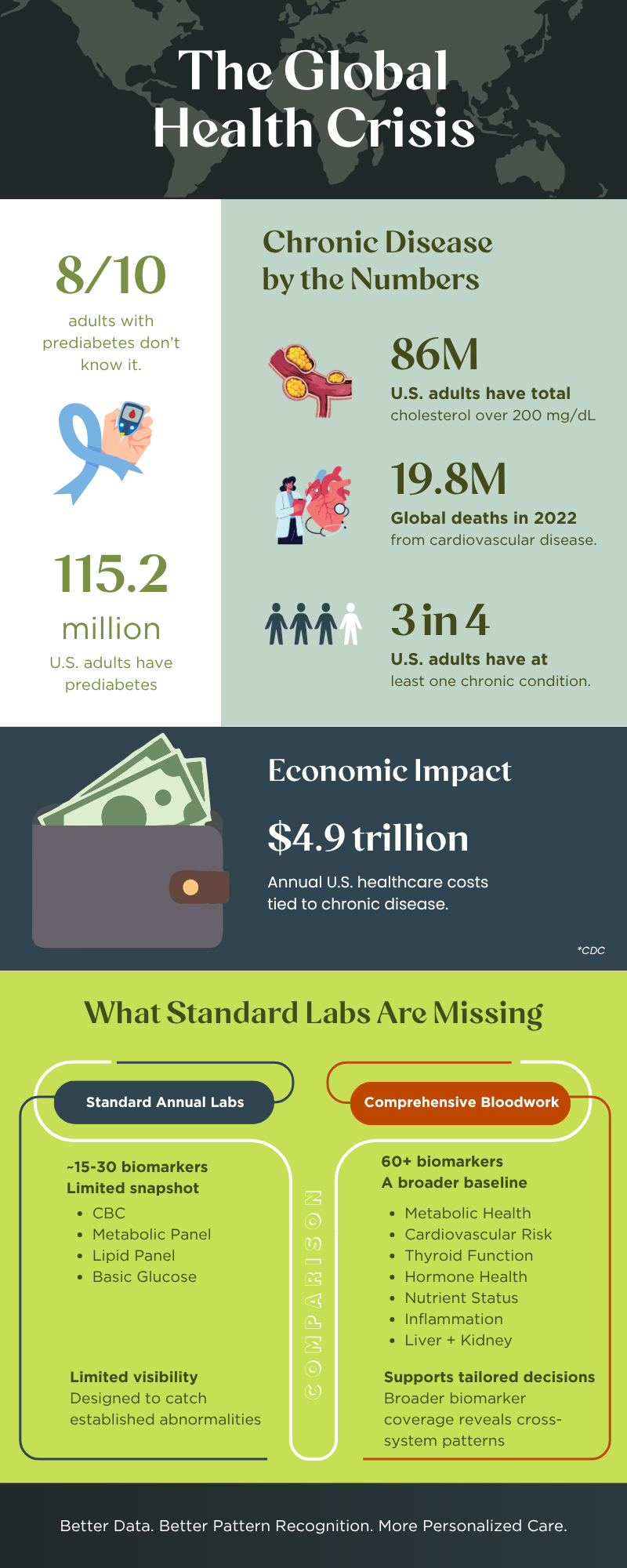
Traditional annual labs typically assess only 15–30 biomarkers. While this may be enough for your primary care provider to identify an already established disease, it's often insufficient to detect early dysfunction, subtle imbalances, or health optimization opportunities.
A comprehensive bloodwork panel evaluates a much wider range of biomarkers, including:
- Metabolic health (glucose, insulin, HbA1c)
- Hormonal balance (thyroid, testosterone, cortisol)
- Cardiovascular risk (lipids, ApoB, inflammation markers)
- Nutrient status (vitamins, minerals)
- Liver and kidney function
- Inflammatory and immune markers
This broader view allows your care team to evaluate how biomarkers interact across systems – revealing patterns that isolated results alone can't capture – which transforms lab testing from a routine checkup into a strategic health roadmap.
Why Bloodwork Is the Starting Point for Personalization
Personalized care isn't guesswork; it's built on data. Your data.
Without baseline biomarkers, even the most advanced health plans rely on assumptions. Comprehensive bloodwork removes that uncertainty by identifying:
- Hidden deficiencies affecting energy, mood, and performance
- Early indicators of chronic disease risk
- Hormonal imbalances impacting sleep, metabolism, and focus
- Inflammation levels linked to long-term health outcomes
This allows care plans to be tailored to the individual, not generalized across populations.
Shifting From Reactive to Proactive Healthcare
Most people engage with healthcare only when something feels wrong. By that point, underlying issues may have been developing for years.
Comprehensive bloodwork shifts the model from reactive to proactive by detecting changes before symptoms appear and tracking trends over time, not just single data points. This enables early interventions that are often simpler and more effective, rather than trying to address issues after they've already progressed.
This approach is especially valuable for preventing conditions like:
- Cardiovascular disease
- Type 2 diabetes
- Hormonal dysfunction
- Chronic inflammation
The Data Behind Proactive, Personalized Care
Comprehensive bloodwork is such a valuable starting point for personalized care because many of the health issues that shape long-term outcomes do not announce themselves early. They build gradually, often without obvious symptoms, until they become harder to ignore and harder to manage.
That matters on both an individual and a public-health level. Chronic diseases remain the leading causes of death and disability in the United States, and they now account for an estimated $4.9 trillion in annual healthcare costs. Most U.S. adults are already living with at least one chronic condition, and many are managing more than one at the same time.
What makes this especially important is that many of the drivers behind these conditions can often be identified well before they fully develop. Prediabetes is a clear example: more than 115 million U.S. adults have it, yet most do not know it. Without testing, those individuals may miss the opportunity to make meaningful changes while the condition is still highly responsive to lifestyle intervention.
The same pattern shows up in cardiovascular health. Heart disease remains a leading cause of death, and common risk factors such as elevated cholesterol are still widespread across the population. In many cases, the underlying signals are present long before someone feels that anything is wrong.
Comprehensive bloodwork also has value beyond long-term disease prevention. It can uncover issues that directly affect how people feel day to day, such as iron deficiency, which remains common in women of reproductive age and can contribute to fatigue, poor performance, and brain fog that might otherwise go unexplained.
Seen together, these patterns point to a simple truth: some of the most meaningful health insights are not visible without testing. Comprehensive bloodwork helps bring those signals into view, creating a clearer picture of where someone stands today and where proactive changes may have the greatest impact. That is what makes it such an important foundation for a more personalized, forward-looking approach to care.
Beyond Bloodwork: What Happens Next?
Bloodwork alone isn't the goal; interpretation and action are.
When you get started with Cōr and complete your initial lab work, your results are then personally reviewed with your dedicated Advocate and medical provider, alongside your symptoms, health history, and goals, to identify meaningful patterns, not just isolated values. From there, your care plan is designed to be both targeted and adaptable, and may include targeted nutrition strategies, lifestyle adjustments and precision therapies when clinically appropriate.
When guided by a trusted, proactive-focused care team, this becomes a continuous feedback loop that refines your health strategy as your body responds to new treatment methods.
Insights Empower Action
A more complete view of your health doesn't just inform care, it changes how you engage with it.
As healthcare continues to evolve – and people are demanding more from their care – there is a clear shift toward increasingly personalized, data-informed models, where decisions are guided by individual biology rather than broad averages. In this context, access to deeper, more meaningful health data becomes a powerful advantage.
It creates clarity. Instead of guessing, you can see where you stand. Instead of reacting, you can make more intentional choices about how you support your health over time.
When you truly understand your health data, you are better equipped to make informed decisions, engage more actively in your care, and build sustainable habits aligned with your biology, your data, and your long-term health goals.
Comprehensive bloodwork is where personalized care begins. The next step is understanding what your data is telling you, and what to do with it.
Sources
Medical Disclaimer: The information in this article is for educational purposes only and is not intended as medical advice. Always consult a qualified healthcare provider before starting any new treatment. Services and medications may not be available in all states.